 DGEMS 2025
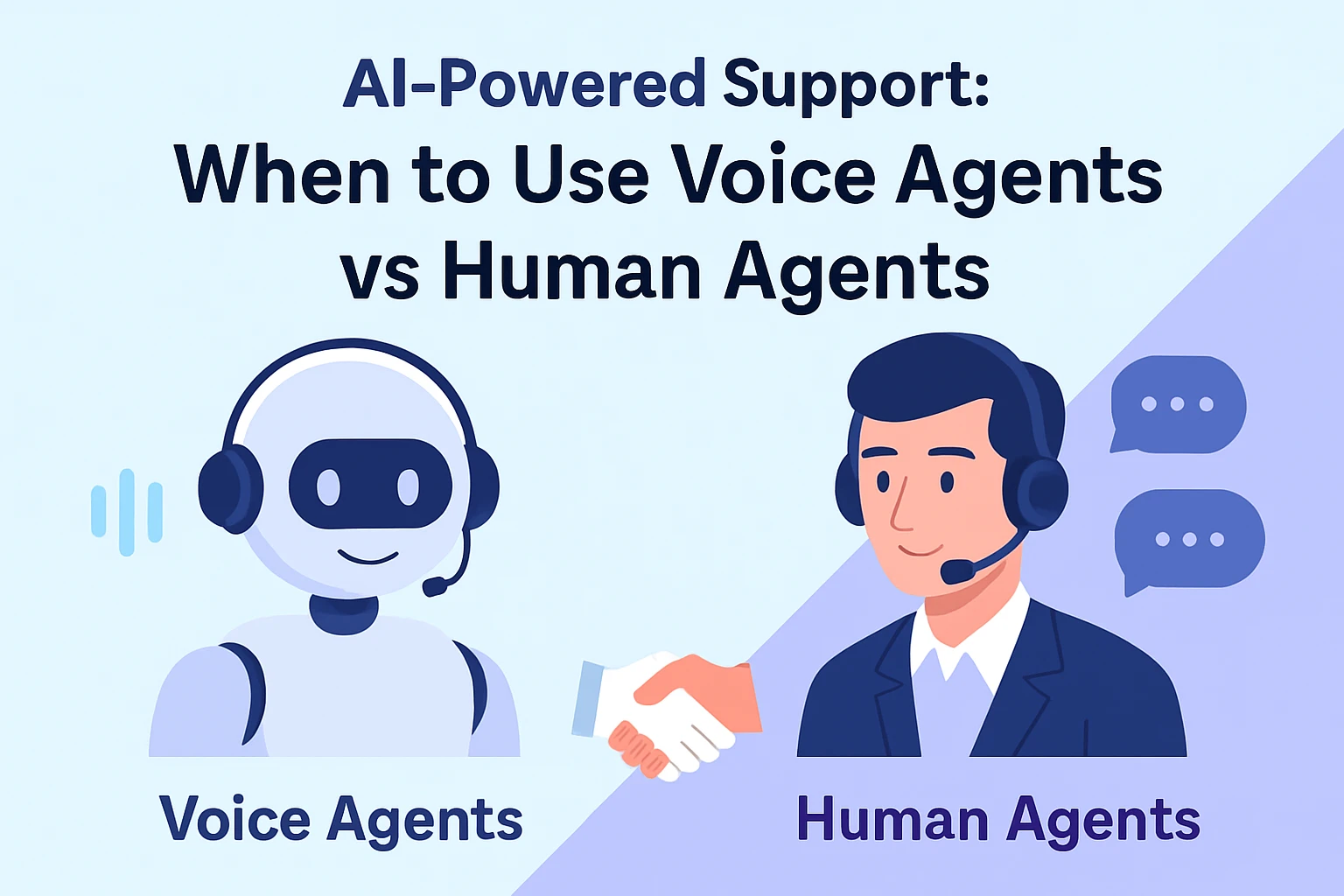

AI-Powered Support: When to Use Voice Agents vs Human Agents
 3 min read
 6/2/2025
Discover when to use AI voice agents vs human agents in customer support. Learn the best use cases, hybrid strategies, and how to scale with AI.
In today’s fast-paced, always-on world, customers expect instant, intelligent, and human-like support—anytime, anywhere. That’s where AI voice agents come in. But here’s the big question: Should you use AI voice agents, human agents, or a mix of both?
In this guide, we’ll break down exactly when to use each, why it matters, and how AI and human agents can work together to deliver exceptional support experiences.
What Are AI Voice Agents?
AI voice agents are advanced, speech-enabled systems that understand, respond to, and even resolve customer queries over phone or voice platforms—without human intervention.
Unlike basic IVRs or chatbots, these agents use technologies like:
- Natural Language Understanding (NLU)
- Contextual memory
- Real-time intent recognition
- Sentiment analysis
Think of them as virtual support reps that never sleep, scale instantly, and learn from every interaction.
When to Use Human Support Agents
While AI has made huge strides, human agents are still irreplaceable in certain contexts:
1. Complex or Emotional Queries
When empathy, nuance, or judgment is needed—such as during disputes, complaints, or sensitive financial matters—humans handle it better.
2. High-Stakes Interactions
In sectors like healthcare, legal, or banking, where accuracy and trust are critical, human oversight ensures compliance and confidence.
3. Unstructured Conversations
If a customer can’t clearly articulate their issue, or if the conversation veers off-script, a trained human can adapt more easily.
When to Use AI Voice Agents
AI voice agents shine in scenarios where speed, consistency, and scalability matter more than human nuance.
1. High-Volume, Repetitive Queries
Think of FAQs like:
- “What’s the status of my order?”
- “How can I reset my password?”
- “What are your store hours?”
AI agents can handle thousands of such calls simultaneously, without breaking a sweat.
2. After-Hours Support (24/7 Coverage)
AI voice agents allow you to offer round-the-clock service—even on holidays—without expanding your human support team.
3. Call Routing & Triage
AI can act as a smart first layer, handling basic queries and escalating complex ones to humans with full context and transcripts.
4. Cost-Sensitive Operations
Startups or lean teams can scale support with AI agents at a fraction of the cost of hiring additional staff.
The Best Strategy: Human + AI Hybrid
Most forward-thinking companies now adopt a hybrid support model:

AI doesn’t replace humans—it empowers them. Brainey’s AI voice agents, for example, can handle Tier-1 queries, gather data, and free up human agents to focus on what they do best: problem-solving and empathy.
Real-World Results from Hybrid AI Support
Companies that integrate AI voice agents into their support workflows have seen:
- Up to 40% reduction in ticket volume
- 30–50% improvement in response time
- 25% increase in CSAT (Customer Satisfaction) scores
- Dramatic savings on staffing costs
Final Thoughts: Choose the Right Agent for the Right Job
AI voice agents are not a “replacement” for human agents—they’re a force multiplier.
👉 Use AI for what it does best: speed, scale, and consistency
👉 Use humans for empathy, creativity, and judgment
👉 Combine both for a future-ready, customer-first support strategy
Looking to integrate intelligent voice agents into your support team?
Talk to Brainey — we’ll help you scale smarter.
FAQs
Q: Are AI voice agents better than chatbots?
AI voice agents often offer a more natural, human-like interaction and are ideal for phone-based or voice-first support experiences.
Q: Can I train AI voice agents with our specific knowledge base?
Yes! Brainey voice agents can be trained on your company’s FAQs, policies, product info, and more.
Q: Do AI agents reduce the need for hiring more human agents?
Absolutely. Many companies use AI agents to handle 60–70% of Tier-1 queries, freeing up human agents for more strategic tasks.